Atelier Journal
Hematite
Golden hematite frames Atelier Lirio's gold edge earrings and bracelets — dark stones, Czech glass, and Oaxacan silk, handcrafted in Mexico City for everyday wear.
By Atelier Lirio ·
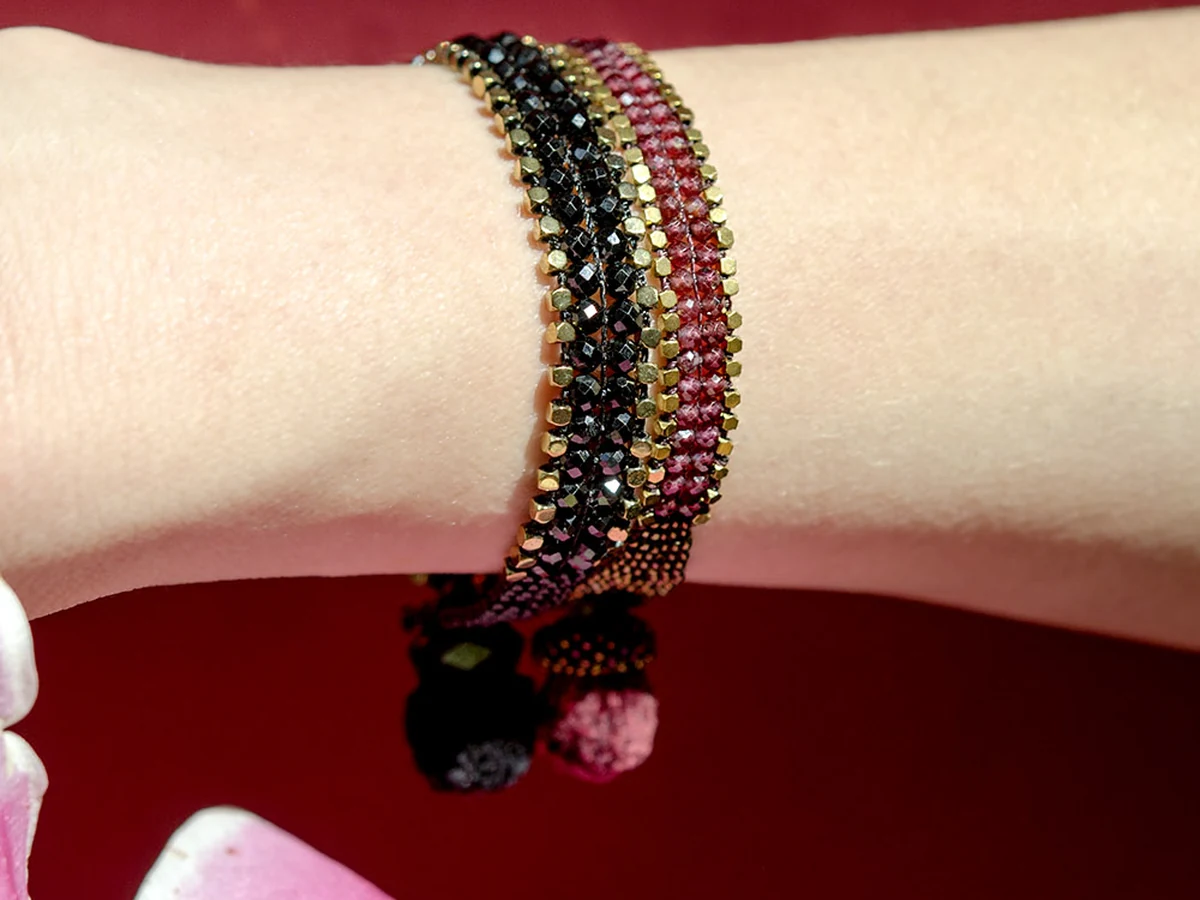
In 2026, jewelry has moved away from stark minimalism toward color and opulent texture. Think deeper jewel tones — like garnet — adorned with richly colored pompoms of Oaxacan silk from the collection. It's the perfect timing to reach for your favorites and stack them. Stacking adds personality and an exuberant edge, and it combines naturally with the jewelry you already own. A highly personal stack of bracelets, one only you can put together, is the way to go. And Gold Edge pieces are among the studio's favorites to stack — a nod to timeless Art Deco geometry, pieces that will belong to your collection for years to come.
Hematite is one of the semi-precious stones in the Atelier Lirio collection, notably in the gold edge family. The Black Spinel Gold Edge Earrings pair black spinel, onyx, and hematite with an Oaxacan silk pompom and the Black Spinel Golden Edge Bracelet repeats the combination with Czech glass beads and a silk pompom of its own. The same hematite bead runs through the garnet, rutilated quartz, and goldstone versions of the bracelets, and through a beaded choker necklace in black spinel and hematite.
As a mineral, hematite is iron oxide — a dense stone with a metallic luster that reads dark gray to silver in its natural state, with a blood-red interior. It is rich in history: ground hematite was used to create the deep red pigment ochre, the very pigment of the earliest cave paintings. The Romans wore hematite as a protective amulet in battle, and the ancient Egyptians believed it held healing and magical properties, placing it in tombs to accompany the dead into the afterlife.
Hematite's place at Atelier Lirio is material and visual — a stone with a metallic body that belongs inside the brand's golden geometry. The gold hematite beads are chosen for how they carry light, and the collection never uses plastic: the beads are stone, glass, and metal.
The stones themselves are carefully selected from suppliers in Mexico, part of a sourcing practice that treats every material as a deliberate choice. The jewelry is handcrafted in the Atelier Lirio studio in Mexico City, and every piece requires 8-9 hours of hand-weaving, beading, and finishing. Metal components are finished with 18K gold plating unless otherwise specified, and selected beads feature 24K gold plating — which is how the hematite's golden sheen reads as continuous with the rest of the piece rather than separate from it.
Design-wise, hematite fits the Art Deco geometry that shapes the collection: clean lines, structured forms, and a focus on wearability over ornament. A hematite bead is a simple, regular form with a metallic presence — exactly the kind of material that belongs in a structured gold edge silhouette. Pieces are designed to be worn 5-7 days a week, and the gold edge family is built for that rhythm: dark stone, golden bead, silk accent, all day.
Context matters here as much as it did for garnet. Vintage Czech glass beads are the defining material of the current collection — they appear in most pieces and are the sole bead material in many — so hematite is not the collection's headline material. Its role is more specific and no less real: a framing material across the entire gold edge line, the quiet golden constant that ties the family together. Atelier Lirio is a small-batch studio; most styles are available in quantities of 1-3, so each gold edge piece is a deliberately limited run.
Care
Because these pieces include silk, they ask for a little more attention than all-metal jewelry:
- Never submerge or soak them. Water is the main thing to avoid — no baths, no washing up, no swimming.
- Wipe, don't rub hard. Use a dry, clean, lint-free microfiber cloth to gently remove body oils and dust when needed.
- Never use steam. Heat and moisture can damage the structural integrity of the pieces, and ultrasonic cleaners are off the table too.
- Store flat. Lay the piece flat in a fabric-lined drawer or jewelry pouch.
- Keep dry. Store away from humid areas like bathrooms, and never put a piece away while it is damp from sweat.
- Keep away from high heat and direct sunlight.